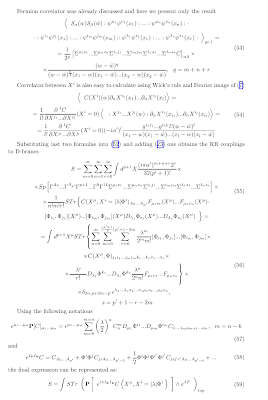
Am not an expert in neither physics nor string theory, but I find these ideas and theories highly fascinating. These ideas look very interesting when we do not go deep into it. like, derivations or proofs....:) Oh.. you want some proof for that...?? Here it is,
The following are the mathematical topics a person has to be familiar with if he wants to learn String theory,
Real analysis
Complex analysis
Group theory
Differential geometry
Lie groups
Differential forms
Homology
Cohomology
Homotopy
Fiber bundles
Characteristic classes
Index theorems
Supersymmetry and supergravity
Need more.... below is just a piece of derivation in string theory...
Looks like we are going to be in deep shit as we go deeper n deeper right...??..:p
So lets all not worry about those n enjoy the little we know.... below videos make these concepts so simple...!! But more importantly, they take you to a different world...!! Enjoy.... (FYI there are 5 parts of the video)
As I mentioned in my previous post Imagining the dimensions higher than 4 looks like impossible right..? But its possible...! To be honest with you, I really have no idea how to write an article about the higher dimensions when myself is stuck imagining 5th dimensions...! So, as would every one would do, I went on exploring about the topic. Seriously, it made me more confused...!! The following is a paragraph which I got on a website, it goes,
The first four are the ones we all know and love: Three dimensions for space and one dimension for time. The other 6 are called 'internal degrees of freedom' and are related to the number of fundamental symmetries present in the physical world at the quantum scale. The equations that physicists work with require these additional dimensions so that new symmetries can be defined that allow physicists to understand physical relationships between the various particle families. They think these are actual, real dimensions to the physical world, only that they are now 'compact' and have finite sizes unlike our 4 dimensions of space and time which seem almost to be infinite in size. Each point in 4 dimensional space-time has another 6 dimensions attached to it which 'particles and forces' can use as extra degrees of freedom to define themselves and how they will interact with each other. Do not confuse them with 'hyperspace' because the particles do not actually 'move' along these other dimensions. They are not 'spatial' dimensions, but are as unlike space and time as time is unlike space! I didn't understand a word...:p But I found this great video on youtube, which explains it beautifully, check it out...
String theory, probably is the hottest thing in the world of physics. Its the most famous idea in the modern physics at the same time, damn confusing..!
Am not going to give you detailed article about the theory, or teach you any derivations..:p but am just give you trailer of the theory, which would tickle your imagination and make you explore about it more.
FYI, this idea will question everything you know and learned till now......So according to the theory,
The idea or the theory starts by saying that the fundamental particles we know are NOT point like dots but made of tiny strings...! These strings are so tiny that no instruments of ours can show it.
We are familiar with 1 dimension, 2D and 3D but string theory predicts the existance of 10 dimensions...!! (I know its hard to imgine even the 4D, but how could we even possible think of 10th dimension...?? I will tell a little about it in the next post... HERE....)
Now the concept of 'universe', its old..! its time for 'multiverse'...!! that's right, according to the String theory, there exist not one but many parallel universes..!! String theory describes 10500 separate universes, with different constants of nature and even different laws of physics. This parallel universe concept is really mindblowing..! Will tell you a little more about it HERE....
Another one of string theory's most dramatic predictions is that we should find cosmic strings. These would be billions of light years long, thinner than a proton and spectacularly dense. As they could reveal themselves in images of distant galaxies, the search is on.
So the physicists say all the particles in the universe are made of tiny strings and how they interact each other is through the vibrations of these strings. Hence they think the whole universe we live in, as a symphony...! Though the idea is revolutionary, and so beautiful, the problem physicists facing is while proving the theory.
Over many many years the dream of scientists to give 'the theory of everything' , a theory that would explain every phenomena in the universe. Many believe that the String Theory is the theory of everything. Is it true...?? Will they able to prove it..?? Lets wait n see..:)
Touch screens nowadays are becoming so common that every gadget in the world is going touch screen. Every person in his day to day life will interact with something which is touch screen. But have you ever wondered what these touch screens are made of..? How do they work..? What's the technology behind it.?
Many people don't know about these. After you finish reading this, you will be amazed by the technology and think of it as a miracle..!
I don't think defining 'touch screen' is necessary as you know what it means. you can easily write,navigate,open windows etc with touch screen. But think of this, ' within fraction of second your touch is your touch is translated into control commands that a computer understands'..! but how..??
To know that, lets look at different type of touch screens.
Capacitive touch screens : Its a wafer thin electrode made of ITO ( indium tin oxide) coated below glass. In such screens, an electrical field is generated on the surface of the screen. That field is disrupted by the user's touch, and electrodes on the edges of the screen measure changes in the current and can thus define the location of the disruption.
Resistive touch screens :Its composed of many layers. The most important are the two electrically conductive layer separated by a small distance. When you touch on it, the two metallic layers become connected at that point.This results in the change in the current and computer locates the point of contact.
Acoustic pulse recognition :It makes you of piezoelectric transducers. They "hear" sound waves caused by the user's touch. Sensors in the edges of the screen measure the amount of time it takes for the pulse to reach the edge, and can then calculate the location of the touch.
There are many other type of touch screens too like surface acoustic wave, optical imaging, self capacitance etc. Please feel free to explore the web...:)
The mobile touch screens what we use everyday uses 'Capacitive touch screens' as they are light and inexpensive. But there is a problem....!! The material used in the manufacture of these screens i.e, ITO (indium tin oxide) is very rare. There are only few deposit of indium anywhere in the world. So thinking of the future, scientists are looking for an alternative for ITO.
Now the updated news in the touch screens technology is that the researchers at Fraunhofer have come up with an alternative to ITO which is as efficient as ITO also cheaper ..!!
Its main components are carbon nanotubes and low-cost polymers. This new electrode foil is composed of two layers. One is the carrier, a thin foil made of inexpensive polyethylenterephthalate PET used for making plastic bottles. Then a mixture of carbon-nanotubes and electrically conducting polymers is added that is applied to the PET as a solution and forms a thin film when it dries.
So now you know about a technology and tell others and make yourself look intelligent..:) So see you when something significant happens in the world of science n technology...:)
Mysteries about space and universe still remain unsolved. Where are we exactly in this universe? How big this universe could be? Are there people like us on some other planets?.... these are some questions that tickle our imagination when we think about it. Existing theories suggest that the universe is expanding..!! Scientists trying to explain the accelerating expansion of the universe usually point to dark matter which is they say is pushing everything apart.
But an Indiana University has a new theory now. According to it " we are living inside a black hole, that exists in another universe.To be specific a black hole that rebounded like a spring".
It gives you goose bumps just by imagining ourselves living inside a black hole isn't it....?? But there is some serious physics involved in this theory.Nikodem Poplawski of Indiana University Bloomington, the scientist who presented this theory used a modified version of Einstein’s general relativity equation set that takes particle spin into account.
Including this variable makes it possible to calculate torsion, part of the geometry of space-time. There is a phenomenon which general relativity can not explain called black hole singularity. Surprisingly this theory of Nikodem Poplawski explains that too....!!
In an earlier study Poplawski said when the density of matter reaches epic proportions, torsion counters gravity. This prevents matter from compressing indefinitely to a singularity of infinite density. Instead, matter rebounds like a spring, and starts expanding again.
Now in his latest study his calculations show that space-time inside the black hole expands to about 1.4 times its smallest size in as little as 10-46 seconds -- two orders of magnitude faster, for lack of a better word, than the Planck time. This brisk bounce-back could have been what led to the expanding universe that we see today.
But the vhilling outcome of Poplawski's theory says we may not be living in our universe at all; we might be living inside a rebounded black hole that exists in a different universe....!!!!!
We could tell by measuring the preferred direction of our universe. A spinning black hole would have imparted some spin to the space-time inside it, which would violate a law of symmetry that links space and time. This might explain why neutrinos oscillate between their antimatter and regular-matter states.
"Maybe the huge black holes at the centre of the Milky Way and other galaxies are bridges to different universes," Poplawski says. If that is correct - and it's a big "if" - there is nothing to rule out our universe itself being inside a black hole.
A flow of methane and hydrogen gas mixture deposits carbon atoms as graphene on a nickel plate. The graphene later is then transferred to a plastic sheet, which is then incorporated into an organic photo voltaic (OPV) cell.
a monocrystalline silicon wafer based solar cell
Energy crisis is the one of the major problems which is giving some really horrifying nightmares for the human race today...!!! So scientists all around the globe have been trying their best to tackle the this situation from a long time and come up with solar power as an answer.
Currently to tap the solar power the most efficient method i.e, using the monocrystalline silicon wafer based solar cells.They convert the sun light directly into electricity by the photovoltaic effect . But the main drawback of this solar cells is that they are not costly.
A large body of research is being done all over the world to manufacture silicon wafer-based solar cells at lower cost and to increase the conversion efficiencies without an exorbitant increase in production cost. The ultimate goal for both wafer-based and alternative photovoltaic concepts is to produce solar electricity at a cost comparable to currently market-dominant coal, natural gas, and nuclear power in order to make it the leading primary energy source. To achieve this it may be necessary to reduce the cost of installed solar systems from currently about US$ 1.80 (for bulk Si technologies) to about US$ 0.50 per Watt peak power.
As a possible solution for this problemA University of Californiateam has produced flexible transparent carbon atom films that the researchers say have great potential for a new breed of solar cells Zhou and the other researchers on the USC team -- which included Yi Zhang, Cody W. Schlenker, Koungmin Ryu, and Mark E. Thompson in addition to Gomez de Arco have recently published a paper in the journal ACS Nano in which they have stated as"Organic photovoltaic (OPV) cells have been proposed as a means to achieve low cost energy due to their ease of manufacture, light weight, and compatibility with flexible substrates," The main critical aspect of OPV photovoltaic cell is that it does not uses silicon but graphene, a highly conductive and highly transparent form of carbon made up of atoms-thick sheets of carbon atoms.To manufacture such sheets a process called chemical vapour deposition is used. In this process, the USC engineering team creates ultra thin graphene sheets by first depositing carbon atoms in the form of graphene films on a nickel plate from methane gas.
Then they lay down a protective layer of thermo plastic over the graphene layer, and then dissolve the nickel underneath in an acid bath. In the final step they attach the plastic-protected graphene to a very flexible polymer sheet, which can then be incorporated into a OPV cell.
But unfortunately such OPV cell are not as efficient as silicon cells."For every 1000 watts of sunlight that hits a one square meter area of the standard silicon solar cell, 14 watts of electricity will be generated," says Lewis Gomez De Arco, a doctoral student and a member of the team."Organic solar cells are less efficient; their conversion rate for that same one thousand watts of sunlight in the graphene-based solar cell would be only 1.3 watts."
Beside their low efficiency by looking on the bright side these OVPs can potentially more than make for in lower price and, greater physical flexibility. "They could be hung as curtains in homes or even made into fabric and be worn as power generating clothing. I can imagine people powering their cellular phone or music/video device while jogging in the sun," say Acro.
So lets hope this really substitutes the silicon and let it make the humans sleep without the 'nightmares'.....!!